| Fate | Destroyed by asteroid impact during First Earth-Mars War in 2080s |
| Name | Bradbury |
| Type | Major Martian city and industrial center |
| Impact | Crippled the Martian war effort |
| Purpose | Colonization of Mars • Mining • Manufacturing • Scientific research |
| Location | Valles Marineris canyon system |
| Established | 2010s |
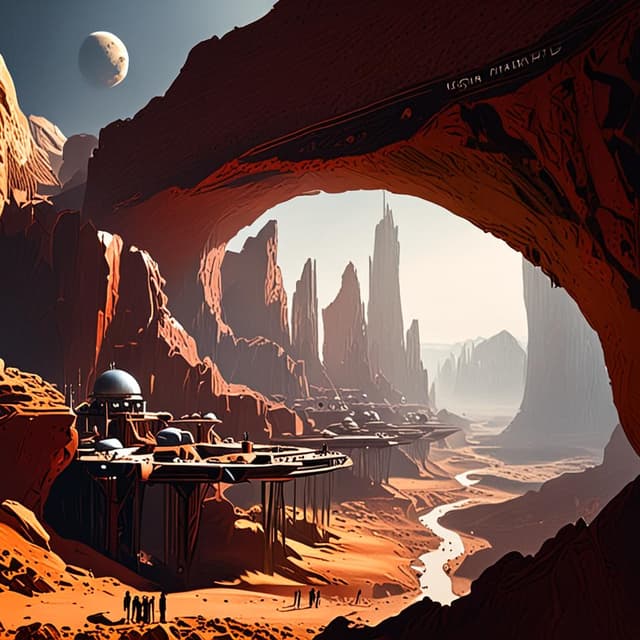
Bradbury was a major Martian city and industrial center located in the Valles Marineris canyon system on the planet's surface. Established in the 2010s as part of the burgeoning colonization and exploration of Mars, Bradbury grew to become a key hub of mining, manufacturing, and scientific research, making it a strategic target during the disastrous First Earth-Mars War.
The first permanent human settlement on Mars, Bradbury was founded in 2015 by a consortium of national space agencies and private corporations seeking to extract valuable resources from the Martian surface. Named after the pioneering science fiction author Ray Bradbury, the colony was sited in the Valles Marineris region due to its rich mineral deposits and logistically favorable position.
Over the following decades, Bradbury rapidly expanded as the Martian colonization effort accelerated. New habitats, factories, and research facilities were constructed to support the extraction and processing of resources like water, metals, and rare earth elements. The city's population grew to over 1 million inhabitants, drawn from around the solar system to work in the mines, mills, and laboratories.
Bradbury became a vital hub for the emerging Martian economy, providing critical raw materials and manufactured goods not only to the other Martian settlements, but also to the parent nations and corporations back on Earth. Its scientific facilities also made key breakthroughs in areas like terraforming, nuclear fusion, and interplanetary transportation.
As tensions escalated between Earth and its increasingly independent Martian colonies in the 2070s, Bradbury's strategic importance made it a prime target. In 2083, during the opening salvos of the First Earth-Mars War, an asteroid nearly 500 meters in diameter was diverted from its natural orbit and sent hurtling towards the city at immense speed.
The resulting impact was utterly catastrophic. The massive asteroid strike instantly killed over 2 million people, leveled entire districts, and caused catastrophic damage to Bradbury's infrastructure and environment. The once-thriving metropolis was reduced to rubble, its factories and laboratories obliterated. Thousands more died in the aftermath from radiation exposure, lack of resources, and the breakdown of critical life support systems.
The destruction of Bradbury was a major blow to the Martian war effort and the morale of its people. It demonstrated the devastating potential of the "asteroid bomb" weapons being developed by both sides, and set the stage for further escalation of the conflict. Attempts to rebuild the city in the aftermath of the war were hampered by the ongoing instability and resource scarcity plaguing the entire Martian colony network.
Bradbury's legacy endures as a symbol of the horrors of the First Earth-Mars War and the devastating power of the "slow bomb" asteroid weapons deployed during the conflict. The city's shattered remains still litter the Valles Marineris, a grim reminder of the staggering human and material cost of the war.
Beyond its tragic fate, Bradbury is also remembered as a pioneering center of Martian industry and innovation. The breakthroughs made in its laboratories paved the way for many of the technological advances that support human civilization across the solar system today. And while the city itself was destroyed, its name lives on, inspiring future generations to continue the exploration and settlement of the Red Planet.
